
Key Takeaways
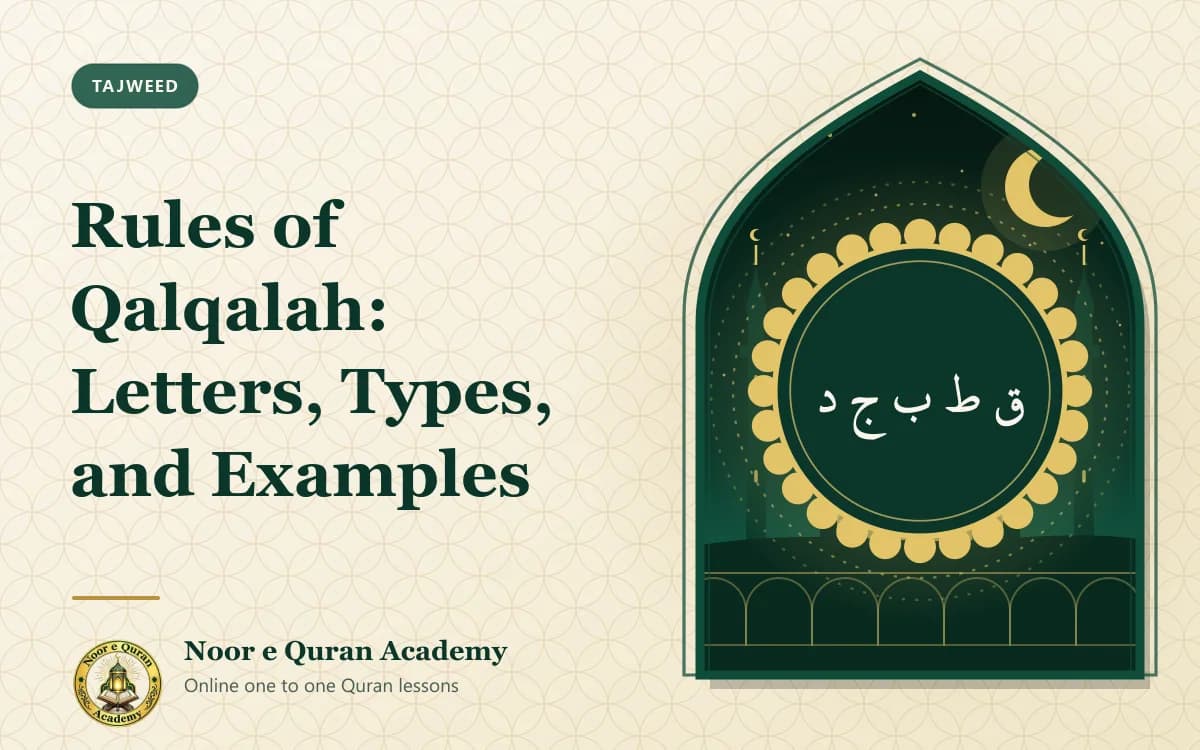
- Qalqalah is a small, distinctive bounce or echo added to five specific letters when they carry sukoon: qaf, taa, baa, jeem, and daal.
- Qalqalah Sughra is a light echo that happens mid-word during continuous recitation.
- Qalqalah Kubra is a stronger, more noticeable echo that happens when you stop on a word ending in one of these letters.
- The phrase "qutb jad" (قطب جد) is a common way to remember the five Qalqalah letters.
- Like most Tajweed sounds, Qalqalah is far easier to learn by hearing it demonstrated than by reading a description.
Qalqalah is a small, distinctive bounce or echo added to five specific letters, qaf, taa, baa, jeem, and daal, whenever they carry sukoon. It comes in two strengths: a light echo during continuous recitation, and a stronger one when you stop on a word ending in one of these letters.
What Qalqalah Means
"Qalqalah" means vibration or disturbance in Arabic, and it describes exactly what happens to these five letters when they carry sukoon, no vowel of their own. Rather than being pronounced flatly, they're given a small, clear bounce, a brief echo that makes the letter more distinctly audible than it would otherwise be.
This isn't decorative. Without it, these particular letters can sound clipped or unclear when they carry sukoon, especially at the end of a word or a stopping point.
The Five Qalqalah Letters
Only five letters carry Qalqalah: qaf (ق), taa (ط), baa (ب), jeem (ج), and daal (د). These are commonly grouped together and remembered using the short phrase "qutb jad" (قطب جد), which strings all five letters into one memorable sequence. No other letters in Arabic carry this specific bouncing quality.
Qalqalah Sughra: The Light Echo
Qalqalah Sughra, the "lesser" or lighter form, happens when one of the five letters carries sukoon in the middle of a word, while you continue reciting through it rather than stopping. The echo here is brief and subtle, present but not heavily emphasised.
Qalqalah Kubra: The Strong Echo
Qalqalah Kubra, the "greater" or stronger form, happens when you stop your recitation on a word ending in one of the five letters, particularly when that letter carries a shaddah. Because you're pausing right at the letter, the bounce is given more room to be heard clearly, making it noticeably stronger than the mid-word version.
A Simple Way to Remember the Letters
Beyond the "qutb jad" phrase, many students find it easier to notice these letters in context rather than memorising them as an abstract list first. A word like Al-Falaq (الْفَلَقِ), ending in qaf, is a common and familiar example, since it's a short surah most students already recognise. Practising with words you already know builds recognition faster than trying to spot Qalqalah in unfamiliar text.
Practising Qalqalah With a Teacher
Qalqalah is typically introduced fairly early in a structured Tajweed course, often around the same stage as the noon and tanween rules, since it's one of the more distinctive and recognisable sounds once you know what to listen for. If you're not yet reading confidently, Noorani Qaida comes first.
Hearing a teacher demonstrate the difference between Sughra and Kubra directly makes this rule click far faster than reading about it. A free trial lesson is a simple way to hear that demonstration for yourself.