
Key Takeaways
- The phrase means "Indeed we belong to Allah, and indeed to Him we will return," and comes directly from Quran 2:156.
- It is said at times of calamity, and most commonly on hearing of a death.
- Sahih Muslim 918 records a dua that the Prophet Muhammad ﷺ taught to say after it, asking Allah for reward in the loss and something better in exchange.
- It is a statement of trust and perspective, not only a formula for funerals.
- Saying it does not mean hiding grief. Sadness and tears are natural, and the phrase gives the sadness somewhere to rest.
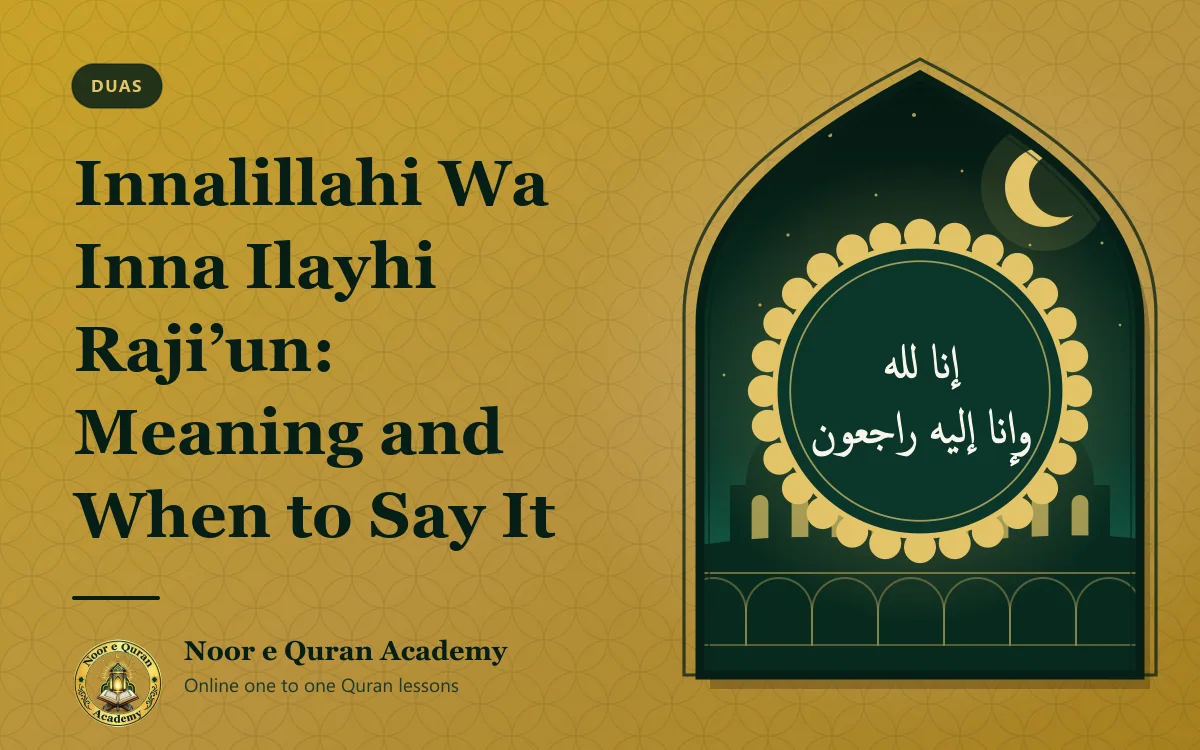
Inna lillahi wa inna ilayhi raji'un means "Indeed we belong to Allah, and indeed to Him we will return." It comes from the Quran and is what a believer says when a calamity strikes, most often on hearing of a death.
The Source in the Quran
The words come from Surah Al-Baqarah. In Sahih International, the verse describes those "who, when disaster strikes them, say, 'Indeed we belong to Allah, and indeed to Him we will return'" (Quran 2:156). It follows a verse promising that believers will be tested, and so it is presented as the believer's response to testing.
What Each Part Means
The first half, "we belong to Allah," is a reminder that life, health, family, and possessions are entrusted to us, not owned outright. The second half, "to Him we will return," places every loss inside a larger picture, that we are all going back to Allah. Together, they give a way of holding grief without losing hope.
The Dua That Follows (Sahih Muslim 918)
Umm Salama reported that the Prophet Muhammad ﷺ said that when a person is struck by a calamity and says "Inna lillahi wa inna ilayhi raji'un" and then asks, "O Allah, reward me in my affliction and give me something better in its place," Allah will reward them and replace it with something better. She said that when her husband Abu Salama died, she said this, and Allah gave her a better replacement, the Prophet ﷺ himself (Sahih Muslim 918).
When to Say It
Most people say it on hearing of a death, and it is also said after other serious losses and setbacks. There is no set number of repetitions. Say it as soon as you hear the news, and return to it whenever the grief comes back.
Grief Is Not a Failure of Faith
Saying this phrase does not mean you must not cry or feel deeply. The Prophet ﷺ himself wept at the death of his son Ibrahim, saying, "The eyes are shedding tears and the heart is grieved, and we will not say except what pleases our Lord" (Sahih al-Bukhari 1303). The phrase gives your sadness a direction, rather than asking you to hide it.
Learning the Wording
The Arabic is short, and a teacher can help you pronounce each word correctly. Our Noorani Qaida course is the starting point for reading, and our Tajweed course builds accurate recitation from there. A free trial lesson is an easy way to begin.